
Environmental Community Newsletter - July 3, 2026
From Compliance to Climate Action — Connecting People, Policy, and Planet

Your packaging waste is now a legal liability. And the food and beverage sector is the one least prepared for what comes next.
The EPR law is already working in the Philippines. The targets are escalating. And it came up at the Envi-Comm Forum last Monday for good reason.
Source · DENR EPR Recognition Program, January 30, 2026 · Jollibee Group EPR Citation
The national plastic packaging recovery rate reached 55.98% — beating the 40% target required under the Extended Producer Responsibility (EPR) Act.
The Philippines hit a milestone in January that most businesses missed: the national plastic packaging recovery rate reached 55.98% — beating the 40% target required under the Extended Producer Responsibility (EPR) Act. EPR is the law that requires large companies to formally manage the plastic packaging waste they put into the market. Companies that miss their targets pay fines of ₱5 million to ₱20 million, or twice the cost of their shortfall — whichever is higher.
But clearing one target does not mean the pressure eases. The recovery rate required for 2025 is now 50%. For 2026, it rises to 60%. By 2028, it reaches 80% — permanently. The law is not getting easier. It is getting stricter every year.
At the EnviComm Forum last June 29, this came up directly. Business owners and compliance officers in the room raised a question that does not have a simple answer: how does a company in food, beverage, or manufacturing actually figure out what its plastic packaging footprint is — and then build a documented program to recover it?
It is the right question. Food and beverage businesses generate some of the highest volumes of covered plastic packaging in the Philippines — sachets, food containers, bottle caps, bags at the point of sale, polystyrene cups and plates. All of it counts. Some of the country’s largest food companies are already acting: the Jollibee Group received a DENR Special Citation this year for exceeding its EPR targets and running recovery programs with government agencies. What the largest players are doing voluntarily today will be mandatory for more companies as enforcement tightens. · · If you are in food, beverage, or manufacturing and you have not yet mapped your plastic packaging footprint, now is the time to start.
Before a manufacturing facility in Talamban can expand, affected stakeholders get a formal seat at the table.
Public scoping for the Ceres Summit Corporation expansion is this Monday, July 6.

Ceres Summit Corporation — a food and pharmaceutical manufacturer in Sitio Kalubihan, Talamban, Cebu City — is expanding its production capacity. Under Philippine environmental law, this expansion triggers a full Environmental Impact Assessment, requiring the company to formally study and address its potential effects on the surrounding area before it can proceed.
Public scoping is a required part of that process. It is a formal session where invited stakeholders — including community representatives, local officials, and government agencies — identify the environmental issues the project must study. Their inputs directly shape the scope of the Environmental Impact Study that the company submits to DENR. · It is one of the most important early steps in responsible development: making sure the right questions are asked before a project moves forward.
Date: Monday, July 6, 2026 · Time: 10:00 AM · Venue: Talamban Barangay Hall, Cebu City · Project: Ceres Summit Corporation — Production Capacity Expansion
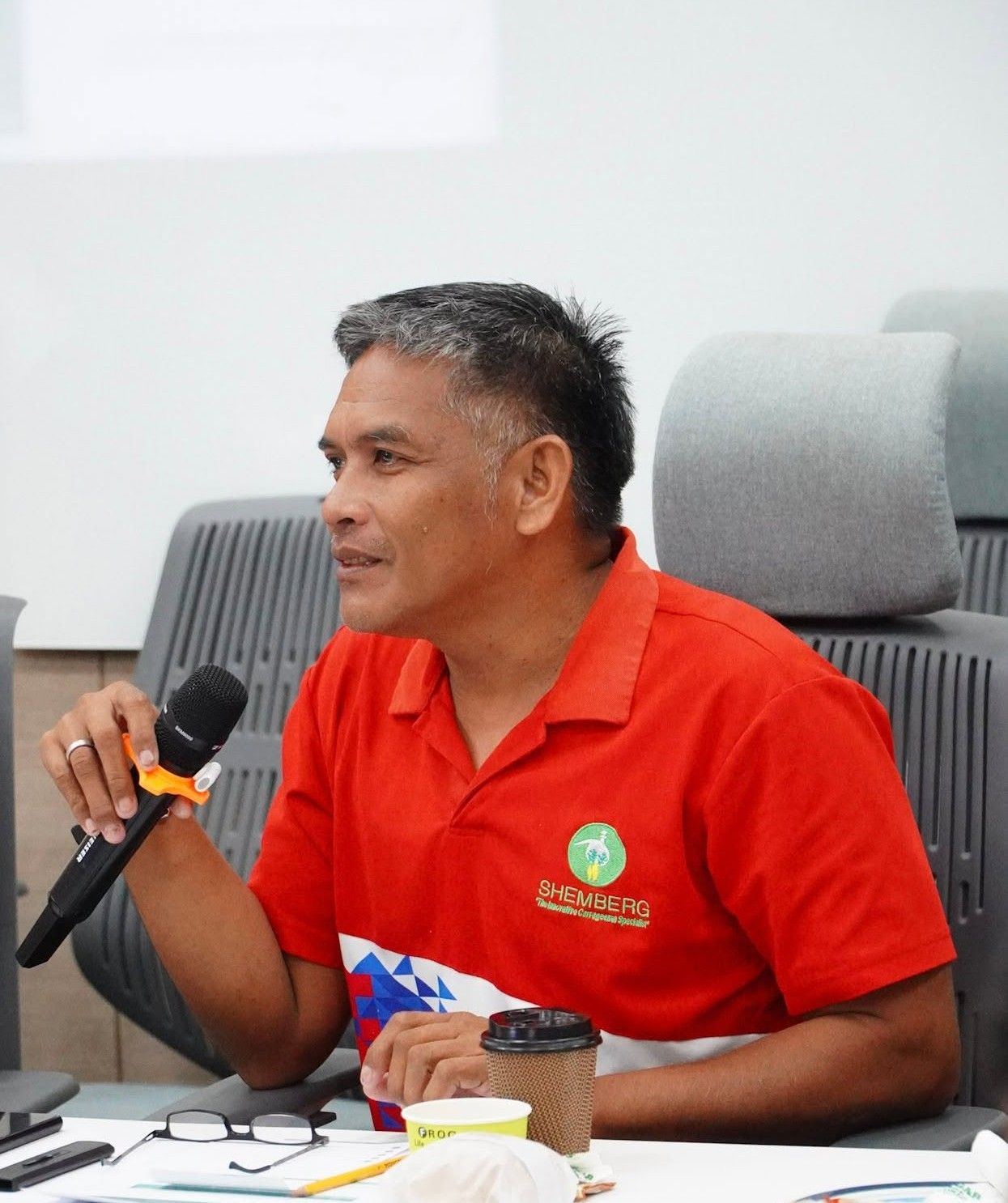
Junasis Alicaway has been keeping Shemberg’s environmental compliance in order for years. At the June Forum, he talked about what that work actually looks like.
❝
regarding sa forum is daghan ta ug na-learn, naa sad tay na-meet nga mga prospects nga makatabang… like sa akoa dako kog problema sa wastewater, sa maintenance — half million, sa testing, sa boiler. Labi na excited ko sa carbon footprint count kay importante man siya kay naa koy boiler.
Junasis C. Alicaway is the Pollution Control Officer of Shemberg Ingredients and Gums Corporation — one of Cebu’s recognized food ingredient manufacturers, known for its carrageenan products used across the food industry worldwide. As PCO, it is his job to make sure the company’s operations stay compliant with Philippine environmental regulations — the permits, the monitoring, the reporting, and everything in between.
At the Envi-Comm Forum last June 29, he sat in a room full of business owners and compliance officers for a frank conversation about what ESG and environmental compliance look like not on paper, but in practice. He shared what it is like to be the person actually doing this work — navigating regulatory requirements, keeping documentation in order, and staying ahead of changes in the law.
Pollution Control Officers are often the quietest people in the room — the ones tracking emissions, filing reports, and coordinating with regulators while the rest of the business runs. Their work is what makes environmental compliance real on the ground.
Is your business covered by the EPR law? Most companies are not sure. Here is a plain-language guide to finding out — and what to do if the answer is yes.
The Extended Producer Responsibility (EPR) Act affects more businesses than people realize. This is what you actually need to know.
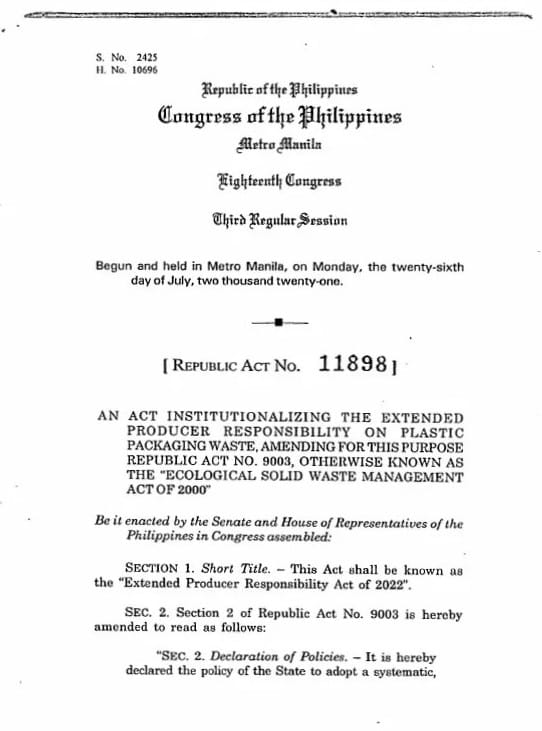
The EPR Act of 2022 (Republic Act No. 11898) requires large companies that generate plastic packaging waste to take formal responsibility for recovering it. If you are not sure whether your business is covered, start here:
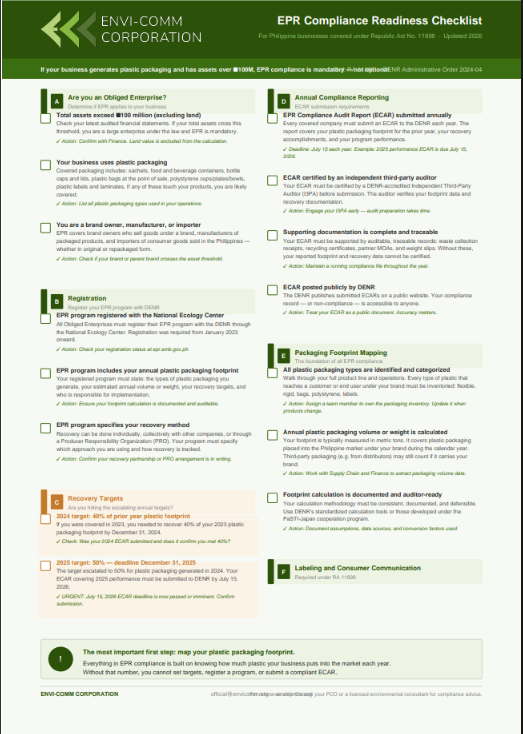
- Do you have total assets exceeding ₱100 million (excluding land)? If yes, you are likely an Obliged Enterprise under the law — meaning EPR compliance is mandatory, not optional. Even if your individual entity is below that threshold, check whether your brand operates under a parent company that crosses it.
- Do you use plastic packaging? The law covers sachets, rigid containers for food and beverages, plastic bags at the point of sale, bottle caps and lids, polystyrene cups and plates, and plastic labels and laminates. If any of these touch your products, your plastic packaging footprint needs to be calculated.
- Have you registered an EPR program with the DENR? All covered companies must register through the National Ecology Center. Your program must state how much plastic packaging you generate annually, how you plan to recover it, and who is responsible for implementation. Registration was required from January 2023.
- Are you hitting your annual recovery target? The target was 40% for 2024. It rose to 50% for 2025. It is 60% for 2026. Companies that miss their target pay a fine of ₱5 million to ₱20 million, or twice the cost of their shortfall — whichever is higher.
- Is your compliance report submitted? Annual EPR Compliance Audit Reports (ECARs) must be submitted to the DENR each year, certified by an independent third-party auditor. The deadline is July 15 of the following year.
If you have not started, the most important first step is to map your plastic packaging footprint — what types of plastic your business generates, and in what volumes. Everything else in EPR compliance is built on that number.
Free Resource
This issue was originally sent to subscribers on Beehiiv .