
Environmental Community Newsletter - July 17, 2026
From Compliance to Climate Action — Connecting People, Policy, and Planet

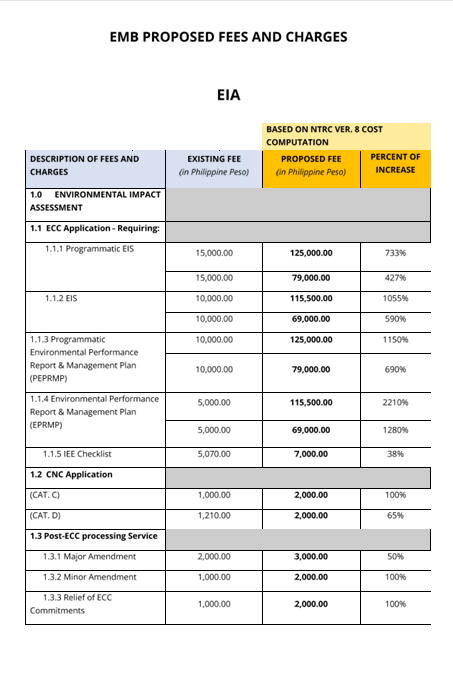
EMB is asking for feedback on a proposed change to what it charges for environmental permits and services. Here is what is being proposed — and how to respond.
The draft amendment to DAO 2016-28 is open for public comment. Envi-Comm is collecting feedback for submission to EMB.
The Environmental Management Bureau (EMB) — the DENR agency responsible for environmental permits and compliance monitoring — has drafted a new Administrative Order proposing updated fees for its regulatory services. This is still a draft. It has not been approved or taken effect.
The services covered by the proposed fee changes include applications for Environmental Compliance Certificates (ECCs) — the permit required before major projects can proceed — as well as registrations for hazardous waste and chemical management, environmental monitoring, laboratory analyses, and permits such as the Permit to Operate (PTO) and Discharge Permit. These are fees that businesses, project proponents, and facility operators pay to EMB when applying for or renewing their environmental permits.
EMB is holding a public consultation to gather feedback from stakeholders before finalising the draft. This is a standard step in how new administrative orders are developed in the Philippines — it is an opportunity for those who will be affected by the fees to put their comments on the official record.
Envi-Comm is compiling feedback to submit to EMB as part of this process. If you want your comments included, you can submit them through the form at the link below. A reference table comparing current fees against the proposed amounts is available inside the form to help you review the specific categories before responding. · · Deadline to submit feedback: August 10, 2026
For more details click here and submit your feedback here!
Bridging the Gap: The Challenges of EMB Compliance for Small Medical Facilities
The EnviComm Forum returns on July 27 — this session is built specifically for birthing clinic owners and small healthcare facility operators.
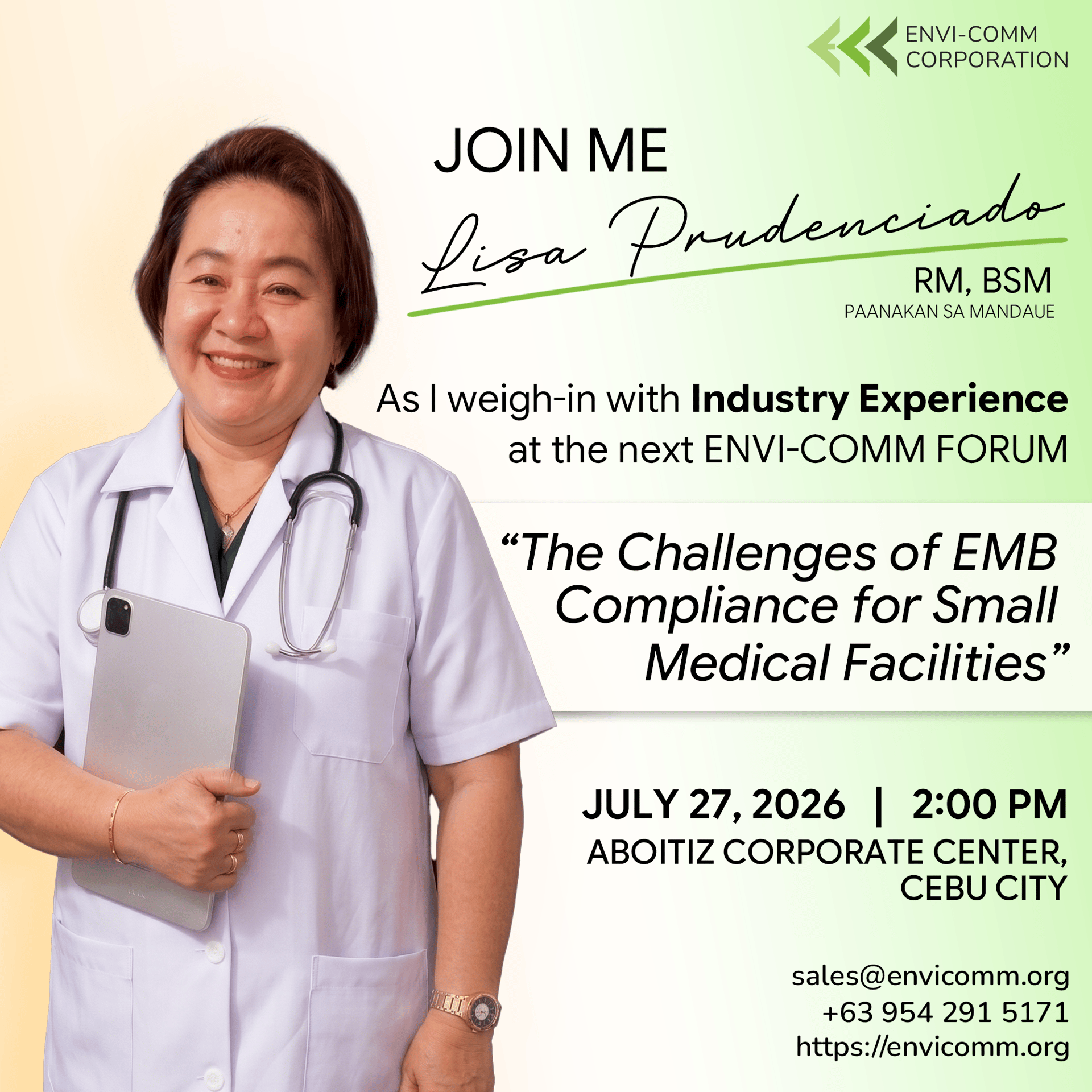
Running a small birthing clinic — or paanakan, as it is known locally — means managing patient care and regulatory compliance at the same time, often with a small team and limited resources. The environmental permits, waste documentation, and reporting requirements that apply to large hospitals apply to small clinics too. But the support systems are not the same.
This month’s Forum tackles that gap directly. The session covers two focused topics: which DENR and EMB permits actually apply to a small paanakan or medical facility, and how to handle infectious and pathological waste properly — including the documentation that proves it was done right.
The discussion runs as a moderated panel, a medical waste handling segment with Waste Monster (a licensed medical waste service partner), and an open roundtable where every participant joins the conversation. Representatives from EMB Region 7 have been invited to the session.
Date: Monday, July 27, 2026 · Time: 2:00 PM – 4:20 PM (Registration from 1:00 PM · Networking until 5:00 PM) · Venue: UG AVR, Aboitiz Corporate Center, Gov. M. Cuenco Ave., Kasambagan, Cebu · Contact:nfgenelazo@envicomm.org | +63 915 461 2702
Dr. Arthur Ibañez is not waiting for electric vehicles to be imported. Cagayan State University is building them — and has already deployed them in communities across the Philippines.
At the 2026 Regional Science, Technology and Innovation Week (RSTW) in Central Visayas, the CSU president walked us through what his team has already made.

❝
We convert traditional tricycle to e-trike…this is an electric buggy which can be used by farmers to transport their produce in a small way. To help the government reduce the carbon footprint. To help the climate, the environment. And of course, to comply with the different sustainable development goals.
Cagayan State University houses the Electromobility Research and Development Center — the only DOST-funded center of its kind in the Philippines. Under Dr. Arthur Ibañez, the university has not just researched electric mobility. It has designed, fabricated, and deployed working vehicles across the country.
The list is remarkable for a state university: electric trikes already running in different provinces, a conversion kit that turns a traditional tricycle into an e-trike, a tram — the blue trambia you can ride in Intramuros — designed and built in Cagayan. An electric bus, now in Manila, preparing for road testing. An electric buggy for farmers. An e-bike. And an electronically powered multipurpose boat for the waters of Cagayan.
At the RSTW, Dr. Ibañez also introduced a battery swapping system — an alternative to charging where EV owners simply swap their depleted battery for a fully charged one in minutes, removing one of the main barriers to electric vehicle adoption in communities where charging infrastructure does not yet exist. · · These are not prototypes on a shelf. They are working vehicles, built by Filipino engineers and researchers, already serving communities. The question now is how far they can reach.
EMB’s permit fees may be going up. Whether or not the proposed increases push through, your outstanding compliance work will cost more if you leave it to later.
A practical look at what the proposed fee revision means for businesses with pending or overdue permits — and why timing matters.
The proposed amendment to DAO 2016-28 covers fee revisions across several categories of EMB regulatory services — ECC applications, hazardous waste and chemical registrations, Permits to Operate, Discharge Permits, and environmental monitoring. The draft is not yet approved and the new fees are not yet in effect.
But here is what that means in practical terms: if the revision is approved, applications filed before the new fees take effect would likely be processed at the current rates. Applications filed after would not be.
Here are the permit categories most likely to be affected, and the compliance situations where timing actually matters:
- Pending ECC applications. If you have a project that needs an ECC and you have been delaying the application, the proposed revision is a reason to move. ECC fees are among the categories covered in the draft.
- PCO accreditation renewal. PCO accreditation from DENR-EMB is valid for three years only. If your Pollution Control Officer’s accreditation is expiring soon — or has already lapsed — now is the time to renew. A facility operating with an unaccredited PCO is a compliance gap regardless of fees. Acting now means settling this at current rates.
- Permit to Operate renewals. PTO renewals for air pollution sources are time-sensitive. Operating with an expired PTO is a violation regardless of fees. If yours is due, file now.
- New Discharge Permit applications. If your facility has expanded or changed its wastewater discharge and has not updated its permit, this is a compliance issue first — and a cost question second.
The proposed fee revision is still a draft. No one can say with certainty whether it will be approved, when it will take effect, or what the final amounts will be. What is certain is that outstanding compliance work does not get cheaper by waiting — and that permit applications take time to process regardless of when fees change.
Free Resource
This issue was originally sent to subscribers on Beehiiv .